
Why preparing for the future beats predicting it
When we ask people what money means to them and their families, we invariably hear one of two answers: “Freedom” or “Security”. Rarely does anyone mention outperforming the market or beating their neighbor’s investment returns. Instead, they want their wealth to support the people, passions, and purpose that form a well-lived life. And they want the security of knowing that an unexpected event or difficult economic environment won’t derail those plans.
Wealth generation is often a different endeavor. It typically comes from a successful career, building a business, getting in on the ground floor of a successful venture, or developing real estate. These pursuits often reward concentrated risk-taking, conviction, and an action-oriented mindset. But the skills and risks required to create wealth are often very different from those required to preserve it. Once that wealth has been created, the challenge shifts. How do we protect it, maintain our lifestyle, and ensure it serves our families and communities for decades to come?
Real wealth isn’t what your portfolio is worth today. It’s the lifestyle and priorities that portfolio can sustain tomorrow. And real risk is losing the ability to sustain it.
At Flatrock, we believe addressing that risk starts with a simple principle: Preparation over prediction.
The Problem with Prediction
Much of the investment industry approaches risk management via forecasting. Predict when the economy will enter a recession. Forecast the next bear market. Anticipate which asset classes will lead and which will lag. If successful, risk management is easy. There’s just one problem. Forecasting is extraordinarily difficult.
Consider Wall Street’s annual forecasts for the S&P 500. As we’ve discussed, even professional strategists armed with extensive research, proprietary data, sophisticated models, and substantial resources routinely miss the mark. Annual consensus forecasts missed actual S&P 500 returns by as much as 26 percentage points in one direction and 21 percentage points in the other.i And these are the experts! As long-time Buffalo Bills coach Marv Levy once quipped about the Super Bowl, “Predicting the winner is easy. Being right, that’s the hard part.”
The problem isn’t simply that predictions are frequently wrong. It’s what investors do with them. The more confident an investor becomes in a particular forecast, the greater the temptation to concentrate capital in the expected winners. Diversification gives way to conviction. And when the forecast proves incorrect, the consequences can be far more damaging.
Worse, repositioning portfolios around changing forecasts can generate transaction costs, unnecessary taxes, and periods when cash sits on the sidelines. Investors may sacrifice the benefits of diversification while incurring additional costs, all in pursuit of an uncertain outcome. We believe a sound investment process should not depend on consistently getting those predictions right.
The All Seasons Investment Process
Our investment process starts by recognizing that families face two distinct financial challenges. The first is short-term resilience. What happens if income is unexpectedly interrupted, a business struggles, or an unforeseen expense arises? The second is long-term wealth and lifestyle preservation. How do we maintain purchasing power and support family, lifestyle, and philanthropic priorities over decades without exposing those plans to an unacceptable risk of permanent loss?
We address these challenges separately, but as part of one coordinated household investment strategy.
1. Protective Reserve – Resilience for the Unexpected
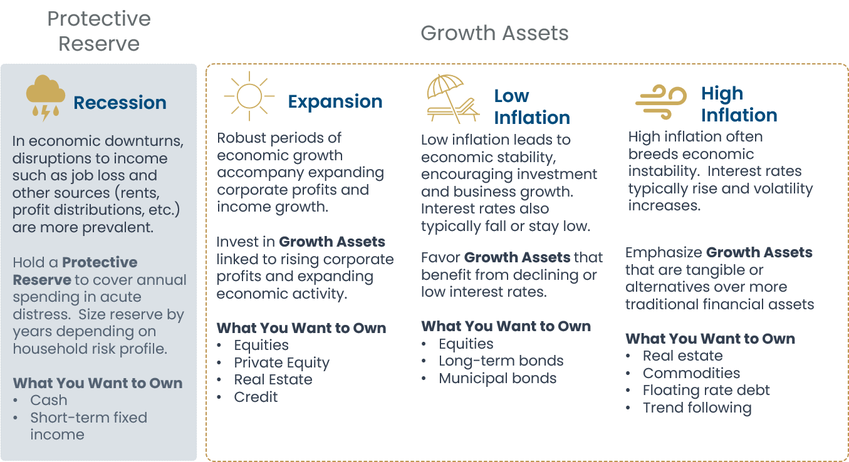
We begin by establishing a Protective Reserve of cash and high-quality, short-term fixed income investments. Rather than assigning a fixed percentage to safer investments, we size the Protective Reserve based on a family’s spending needs and unique circumstances. For some households, that may mean a Protective Reserve to cover a year of spending. For others, several years may be appropriate.
Consider a family whose current income comes primarily from a job, an apartment portfolio or a successful small business. A business downturn or layoff can reduce that income to zero in an instant. A natural disaster could interrupt rental income for months. A pandemic could temporarily shut down a car wash or restaurant. These are not hypothetical categories of risk, as anyone who lived through a career setback, COVID or a major California wildfire can appreciate. Regardless of its source, income can disappear almost overnight. Unfortunately, household expenses rarely disappear with it.
The Protective Reserve is designed to provide accessible resources that may help a family maintain its lifestyle through such disruptions, reducing the need to sell long-term investments at an inopportune time. There’s an additional benefit. Because income disruptions often coincide with recessions, the Protective Reserve also provides a measure of protection during difficult economic periods. We’ve written about this in greater detail here.
2. Growth Assets – Preparing for Every Economic Season
With near-term needs addressed, the remaining assets can focus on longer-term objectives. Here’s where our All Seasons philosophy comes into play.
Like the seasons, economic environments change. Sometimes the economy expands robustly. Sometimes recessions occur. Inflation can be low and stable for years, then unexpectedly accelerate. Different investments respond differently to these conditions. Stocks and credit often benefit from economic expansion. Bonds tend to perform well when inflation and interest rates decline. Real assets may provide benefits when inflation rises. Rather than attempting to predict which environment comes next, we seek a diversified mix of investments with the potential to perform across different economic seasons.
For illustrative purposes only. Asset classes may respond differently to economic conditions than depicted, and relationships may change over time. No investment or combination of investments is assured of providing positive returns in any particular economic environment. Diversification does not guarantee a profit or protect against loss.
The exhibit illustrates a simple concept. We don’t need every investment to perform well in every environment. We want at least some investments that may benefit from each environment. This is diversification in its most practical form.
An All Seasons Approach to a Cross-Country Trip
Imagine embarking on a multi-month journey from Alaska to Florida in the family car. Along the way, you’ll encounter snow, rain, sunshine, and plenty of unpredictable road conditions. One approach would be to check the forecast each morning and change your tires accordingly. You could do that, but you’d spend a lot of time and money at tire shops. And what happens when the forecast is wrong?
A more practical solution is to equip your vehicle with all-season tires designed to handle a wide range of conditions. They may not be optimal for every mile of the journey, but they can help you navigate varying conditions without continually changing equipment. We think investing works much the same way. Instead of continually repositioning portfolios based on forecasts, we seek an allocation designed to navigate a wide range of economic conditions while avoiding the costs, taxes, and potential mistakes associated with repeatedly changing course.
Investment Craftsmanship Still Matters
Does an All Seasons allocation mean our work is done? Hardly. Every family’s circumstances are different. One may have substantial income from a private business. Another may rely on a concentrated stock position. A third may have legacy family real estate holdings. In our cross-country analogy, everyone is driving a different vehicle.
That’s why we don’t believe in one-size-fits-all model portfolios. We continually evaluate how to implement each family’s allocation more intelligently. Can we lower investment costs? Reduce unnecessary taxes? Locate assets in more appropriate accounts? Find better investment structures? Discover more efficient ways to implement strategies? Importantly, diversification should consider the family’s entire balance sheet, not just its investment accounts. A household whose wealth and income are heavily tied to real estate, for example, may have different investment needs than one whose wealth comes primarily from a corporate career.
Admittedly, these details aren’t particularly exciting. No one goes on CNBC to discuss tax-efficient asset placement, portfolio customization or minimizing costs. And that’s fine with us. We’d rather be boring and effective than exciting and inefficient. Because little things make big things happen. Thoughtful investment craftsmanship, particularly when it comes to managing costs and considering tax consequences, can help preserve more of a family’s wealth for its intended purpose.
A Little Humility Goes a Long Way
Our founders spent nearly 60 years in institutional investment management. They’ve had the privilege of working with leading academics, sovereign wealth funds, and accomplished portfolio managers. If those experiences have taught us anything, it’s humility. Markets are extraordinarily complex. The future is uncertain. And even the brightest minds regularly get it wrong.
We don’t believe financial security should depend on our ability – or anyone else’s – to consistently predict what happens next. Instead, we believe thoughtful design, diversification, and investment craftsmanship can help families navigate uncertainty and seek to reduce the likelihood that adverse market conditions permanently disrupt their financial plans.
Because ultimately, the goal isn’t to win every market environment. It’s to preserve the freedom and security that wealth was meant to provide in the first place. And that, in our minds, is what allows families to live with greater confidence and intention. And isn’t that what a wealth partnership is designed to create?